Section 1
Your Essay — Errors Highlighted
Each error is marked in red with a number. Find the full explanation for every number in Section 2.
"Persepolis" is an autobiographical graphic novel written by Iranian author and artist Marjane Satrapi. It is a coming-of-age story that's1 told from the childhood memories of the main character, Marji (author's alter ego). Her story starts from the 1979 Islamic Revolution, the establishment of Ayatollah Khomeini's theocratic regime, and the Iran-Iraq war.
The first part of the novel shows readers a naive, child2 perception of the political and cultural problems that the country faced on the eve of revolution3. Marji, as a child, tries to perceive why the familiar world around her is collapsing. She observes the terror unleashed by Shah's4 regime. The novel describes the most significant events of modern Iran from a child's point of view.
Her story starts when Marji is only 10 years old — she is a smart and inquisitive girl. As5 any other child she spends most of her time daydreaming and fantasizing. But everything changes rapidly when a child's immature psyche encounters harsh reality. As the main character grows up and realizes that something terrible is happening around her, that people are dying, and firstly7, her loved ones.6
The central theme of "Persepolis" is emancipation. Marji always wanted8 to become a chemist and to be a progressive, modern woman. She turns out9 to be a very brave girl. She understands that they10 are trying to take away her individuality and lock her in a cage. But still, out of protest, she allows herself to say and do everything she thinks, even to the the11 guards of the Islamic Revolution. This, of course, leads to many interesting12 consequences.
Satrapi chose13 the comic book format to tell her story for a reason14. As she said15, this form of presentation will allow16 the reader to break down the one-dimensional image of her country and Iranian women. It helps to overcome the barrier of intolerance and begin a deeper and more meaningful discussion of the problems and the status of women in modern Iranian society.
Section 2
All Corrections & Explanations
| # | Error | Correction | Category | Why |
|---|---|---|---|---|
| 1 | that's | that is | Register | Contractions are never used in IELTS Academic Writing. Expand every apostrophe: it's → it is, she's → she is, that's → that is. |
| 2 | child perception | child's perception | Grammar | A noun modifying another noun needs the possessive ('s) when showing ownership or association. "Child's perception" = the perception belonging to / typical of a child. |
| 3 | eve of revolution | eve of the revolution | Article | This refers to a specific, known revolution (the 1979 Islamic Revolution mentioned in the previous sentence). Specific nouns already identified take the definite article the. |
| 4 | Shah's regime | the Shah's regime | Article | Unique historical titles always use the: the Shah, the King, the Pope, the Tsar, the President. Russian has no articles, so this must be applied consciously every time. |
| 5 | As any other child | Like any other child | Lexical | LIKE + noun = "similar to" (comparison of similarity). AS + clause (subject + verb) = "in the way that / in the role of." Russian как covers both — English splits them. Here we compare similarity → like. |
| 6 | As the main character grows up… her loved ones. | As the main character grows up, she realises that something terrible is happening — that people are dying, especially her loved ones. | Grammar | SENTENCE FRAGMENT. "As" is a subordinating conjunction — it creates a dependent clause that needs a main clause to complete it. The sentence has no main verb that could stand alone. Add the main clause: "she realises…" |
| 7 | firstly | especially / above all | Lexical | "Firstly" is used to introduce the first item in a list (firstly… secondly… finally). The student means "most importantly / above all" (Russian: прежде всего). These are different words with different meanings. |
| 8 | wanted | wants | Tense | LITERARY PRESENT. When analysing a text, all verbs describing what a character does are written in present tense, regardless of when the story is set. The book exists now; what Marji does in it is described in present tense. |
| 9 | turns out to be | proves to be | Register | Phrasal verbs (turn out, find out, come up with) are informal. Replace with a single formal verb: turns out → proves, finds out → discovers, comes up with → develops/devises. |
| 10 | they | the regime | Grammar | VAGUE PRONOUN REFERENCE. "They" has no clear antecedent in the previous sentence. An examiner cannot tell who "they" refers to. Always name the subject clearly: the regime, the authorities, the Revolutionary Guards. |
| 11 | the the | the | Proofreading | Duplicate article — a typo that signals the essay was not proofread. Reserve 5 minutes at the end of every IELTS task for proofreading. |
| 12 | interesting consequences | significant / serious consequences | Lexical | "Interesting" is vague and journalistic. IELTS Band 7 Lexical Resource requires precise vocabulary. Choose a word that conveys the actual meaning: significant (important), serious (dangerous), profound (deep/lasting). |
| 13 | chose | chooses | Tense | LITERARY PRESENT. When discussing the author's decisions as they appear in the text, use present tense: Satrapi chooses, depicts, argues, shows, uses. |
| 14 | for a reason | deliberately / with clear intent | Register | "For a reason" is a conversational filler that adds no information. Replace with a word that carries actual meaning. If you mean "on purpose" → deliberately. If you mean "not without thought" → with clear intent. |
| 15 | As she said, | As Satrapi has argued, | Register + Grammar | Two issues: (1) "she said" is informal — academic writing uses argues, states, explains, asserts, contends. (2) Use the author's full name or surname, not "she." (3) Present perfect (has argued) is preferred when the idea remains current. |
| 16 | will allow | allows | Tense | With literary present ("has argued"), there is no need for future tense. The book does this now — use present simple: "this format allows the reader to…" |
Section 3 — Grammar Focus
The Passive Voice
Passive voice is one of the most important grammatical structures for IELTS Band 7+. It appears in Task 1 process descriptions, Task 2 academic arguments, and Speaking. Examiners explicitly reward it as evidence of grammatical range.
What Is Passive Voice?
In active voice, the subject performs the action:
Satrapi wrote the book. (Satrapi = subject; does the writing)
In passive voice, the subject receives the action:
The book was written by Satrapi. (The book = subject; receives the writing)
The agent (who did it) can be omitted when it is unknown, unimportant, or obvious:
The book was published in 2000. (We don't need to say "by the publisher")
The Formula
The verb be carries the tense. The main verb is always in past participle form (written, published, introduced, forced, believed…).
Passive in Every Tense
| Tense | Formula | Example |
|---|---|---|
| Present Simple | is/are + pp | Women are expected to wear the hijab. |
| Past Simple | was/were + pp | The revolution was described through a child's eyes. |
| Present Continuous | is/are being + pp | The situation is being monitored closely. |
| Past Continuous | was/were being + pp | New laws were being introduced every month. |
| Present Perfect | has/have been + pp | The book has been translated into many languages. |
| Past Perfect | had been + pp | The regime had been established before the war began. |
| Future Simple | will be + pp | More research will be needed in future. |
| Modal | modal + be + pp | This issue must be addressed urgently. |
| Impersonal | It is + pp + that | It is widely believed that education is the key to success. |
When to Use Passive Voice in IELTS
- Task 1 — Process diagrams: "The material is heated to 400°C, then is cooled rapidly."
- Task 2 — Academic argument: "It is widely argued that technology has transformed modern education."
- When the agent is unknown: "The law was changed in 1979." (we don't need to say who changed it)
- When the agent is obvious: "The suspect was arrested." (obviously by police)
- To sound more formal: "Mistakes were made" is more formal than "They made mistakes."
- To vary sentence structure and demonstrate grammatical range to the examiner.
Note for Russian Speakers
Russian uses passive voice less frequently than English, preferring reflexive constructions (-ся / -сь): Книга была написана (passive) vs книга написана or книга пишется (reflexive).
In English academic writing, passive voice is strongly preferred and sounds more formal than active. You should consciously practice building passive sentences until they feel natural.
Common Russian-speaker errors:
- Using active where passive is expected: "People widely believe that…" → "It is widely believed that…"
- Wrong past participle: "was wrote" → "was written"
- Omitting be: "The book published in 2000" → "The book was published in 2000"
- Wrong form of be: "The laws is changed" → "The laws are changed"
Section 4 — Practice
Passive Voice Exercises
All exercises use IELTS-level topics and vocabulary. Complete each exercise, then click "Show Answers" to check.
Rewrite each sentence in passive voice. The agent (by…) is only needed if it adds important information.
Use the verb in brackets. Choose the correct tense of the passive.
Each sentence contains one passive voice error. Identify it and write the correction.
Section 5 — Speaking Practice
IELTS Speaking — Record Your Answer
Press Record to answer each question aloud. Your recording plays back immediately so you can listen and self-evaluate. Aim to speak without stopping — fluency matters as much as accuracy.
1. Record your answer using the Record button below each question.
2. Listen back — if you're not happy, record again.
3. When you're satisfied, click ⬇ Download to save the audio file.
4. Send all your downloaded recordings to your teacher via WhatsApp or Telegram.
⚠ Recordings are NOT saved on this page — if you close the tab without downloading, they will be lost.
Part 1 — Level 1 Questions (Familiar Topics)
Short answers · 2–3 sentences · Personal, everyday topics
Part 2 — Level 2 Cue Card (Extended Response)
1 minute to prepare · Speak for 1–2 minutes · Use the cue card bullet points as a guide
Section 6 — Your Answers
Passive Voice — Your Answers Corrected
Here are your submitted answers with detailed corrections. Green = correct, red = needs fixing.
Exercise A — Active to Passive Transformations
1. Correct
"The new education policies were introduced by the government."
2. Unnecessary Rephrasing
Corrected: "A new approach to teaching has been discovered (by researchers)."
Your passive is grammatically fine, but you changed the meaning: "a new approach to teaching" became "a new teaching approach". In a transformation task, the meaning must stay identical. Simply lift the object as it is.
3. Spelling Error
Corrected: "The standardised tests are used by many countries to measure student progress."
"standartised" is misspelled. Correct spelling: s-t-a-n-d-a-r-d-i-s-e-d. The passive form and tense (present simple) are both correct — well done!
4. Correct
"Millions of people will be affected by climate change in the next decade."
5. Wrong Tense
Corrected: "The revolution is depicted through a child's eyes by Satrapi."
The active sentence uses present simple ("Satrapi depicts"), so the passive must also be present simple: IS depicted — not WAS depicted. Rule: the tense of the passive verb must match the tense of the original active verb.
6. Wrong Tense + Contradictory Adverb
Corrected: "New research on air pollution is currently being conducted by scientists."
Two errors: (1) Tense: "are currently conducting" = present continuous → passive = IS currently BEING conducted. (2) "currently" signals an action happening right now — it cannot be used with past simple "was". The word "currently" and "was" contradict each other.
7. Wrong Modal Verb
Corrected: "The issue of student mental health must be addressed by schools."
"Schools must address" uses MUST (strong obligation). In the passive, the modal is kept unchanged: must be addressed. "Should" (recommendation/advice) and "must" (obligation/necessity) have different meanings — they are not interchangeable.
8. Correct
"The government's decision has been widely criticised."
Exercise B — Passive Voice in Context
1. Correct
"The graphic novel was published in France in 2000, but it was soon translated into many languages."
2. Correct
"It's widely argued that graphic novels have been overlooked as serious literature for too long."
3. Tense Error: "since" requires present perfect
Corrected: "Women in Iran have been forced to wear the hijab since 1979."
"Since" always requires present perfect (or past perfect in a past context) — never past simple. Rule: SINCE + present perfect = action/state that started in the past and continues now. "Were forced" is finished/over; "have been forced" = started in 1979 and is still happening.
4. Correct
"Before the revolution, Western culture was allowed in Iran, but all of that was changed overnight."
5. Correct
"More research is needed before any firm conclusions can be drawn."
Exercise C — Find and Correct the Error
1–5. All Correct
1. "The book was written by Satrapi in French." — Past simple passive. was + written (past participle).
2. "The revolution is described in great detail..." — Present simple passive. Agent omitted.
3. "She was forced to leave her country." — Past simple passive + to-infinitive.
4. "The results were announced by the committee yesterday." — Past simple passive. Agent kept (important info).
5. "It is believed that education is the key to success." — Impersonal passive — common in academic English.
Your Error Pattern Summary
| Error type | Count | Key rule |
|---|---|---|
| Tense mismatch | 2 | The passive tense must match the original active tense exactly |
| Wrong modal verb | 1 | Keep the same modal: must → must be done; should → should be done |
| Since + present perfect | 1 | "Since" always requires present perfect: have/has been + pp |
| Unnecessary rephrasing | 1 | Keep the object exactly as it appears in the active sentence |
| Spelling | 1 | standardised — memorise the spelling |
New Practice — Based on Your Errors
Keep the tense identical to the active sentence.
Section 7 — Speaking Feedback
Your Speaking — Transcripts & Corrections
Your recorded answers are transcribed below with error corrections and praise for what you did well.
Said: "when I was in child"
Better: "when I was a child" or "when I was younger"
We say "a child" (countable noun). "In childhood" also works: "not as I did in childhood."
Said: "a bit sarcastic"
Better: "a bit satirical" or "slightly ironic"
"Sarcastic" describes a person's tone/attitude. Books (especially for young adults) are described as "satirical", "ironic", or "darkly humorous".
Said: "Eric From"
Better: "Erich Fromm"
The name is German-origin: Erich (not Eric) Fromm (double m). In speaking this is fine — worth knowing for writing.
Said: "Art of Love"
Better: "The Art of Loving" (1956)
Very close! Minor slip — not penalised in speaking.
Said: "her main idea"
Better: "its main idea" or "the book's main idea"
Books use "it/its", not "she/her". We only say "she" for ships, countries, or when a narrator is specifically personified.
Said: "it will make him involved more"
Better: "it will make the reader more involved in the story"
With "make + object + adjective", the adjective comes right after the object: make them MORE INVOLVED (not "involved more").
Said: "make him involved"
Better: "make the reader more involved" or "draw them in"
The generic pronoun "him" is outdated in modern English. Use "the reader", "them", or restructure.
Said: "are a good way to discuss"
Better: "are an effective medium for exploring" or "are a powerful way to address"
For a higher band, replace generic "good" with: effective, powerful, valuable, compelling.
Said: "the simple presentation of a serious topic"
Better: "the visual/accessible format" or "the combination of image and text"
What makes graphic novels distinctive is their visual storytelling, not "simplicity". Being specific shows stronger lexical resource.
Said: "I would prefer fiction more"
Better: "I would prefer fiction" or "I'd go with fiction"
"Prefer" already means "like more", so adding "more" is redundant.
Said: "I mostly read philosophy, for example."
Better: "I mostly read philosophy — Erich Fromm, for example." or just "I mostly read philosophy."
"For example" implies you're about to give an example. Here it's dangling at the end with nothing after it.
Said: "mystery and thrillers and romance"
Better: "mystery, thrillers, and romance"
For three or more items, use commas. Repeating "and" sounds like a list that hasn't ended.
Said: "reading in my country has been replaced"
Better: "reading books in my country has largely been replaced"
Adding "books" makes it clearer. "Largely" adds nuance and sounds more academic.
Part 3 expects developed answers. Try to add a reason or opinion: "I think this is partly because..." or "However, I believe..." to extend.
Said: "Dead Poet Society"
Better: "Dead Poets Society" (plural)
Minor slip — completely understandable in speaking.
Said: "deeply passionate about poets poems"
Better: "deeply passionate about poetry" or "passionate about poems and poets"
Said: "this movie had a very strong impression on me"
Better: "this movie made a very strong impression on me"
The fixed phrase is "make an impression on someone". We say "the film made a strong impression" — not "had". Very common learner error.
Said: "a gap between parents and kids"
Better: "a generation gap" or "the conflict between parents and children"
"Generation gap" is the standard expression.
Said: "he struggles with parents understanding his passion"
Better: "he struggles because his parents don't understand his passion"
The original phrasing is grammatically awkward (gerund subject). The rewrite is clearer.
Said: "So they start..." / "So. So he decides..."
Better: Vary with: "As a result," / "Because of this," / "In the end,"
Starting multiple sentences with "So" lowers your Coherence band. Mix in other connectors.
Section 8 — Vocabulary & Paraphrasing
Vocabulary Practice — Rewrite & Summarise
These exercises build the paraphrasing skills you need for IELTS Band 7+. Rewriting complex sentences in your own words proves you understand the meaning — not just the words.
Part A — Rewrite in Your Own Words
Read each statement carefully. Then rewrite it using different vocabulary and sentence structure while keeping the same meaning. Write your version in the box below.
Part B — Summarise this Text
Read the passage below carefully, then write a summary in 3–5 sentences. Use your own words — do not copy phrases directly from the text. Focus on the main ideas, not the details.
The concept of emotional intelligence, popularised by psychologist Daniel Goleman in the 1990s, refers to an individual's ability to recognise, understand, and manage their own emotions, as well as the emotions of others. Unlike traditional measures of intelligence such as IQ, emotional intelligence encompasses skills like empathy, self-awareness, and social competence.
Research has consistently shown that people with high emotional intelligence tend to perform better in the workplace, maintain healthier relationships, and experience greater overall well-being. In leadership roles, emotional intelligence is often considered more important than technical expertise, as leaders must navigate complex interpersonal dynamics, resolve conflicts, and inspire trust among their teams.
Critics argue, however, that emotional intelligence is difficult to measure objectively and that the concept has been oversimplified by the self-help industry. Some psychologists question whether emotional intelligence is truly a distinct form of intelligence or simply a collection of personality traits. Despite these criticisms, the idea that success depends on more than just academic ability has gained widespread acceptance in education and corporate training programmes worldwide.
Section 9 — Collocations
Collocation Practice
Collocations are words that naturally go together in English. Using the wrong combination sounds unnatural even when the grammar is correct. These exercises target collocations that appear frequently in IELTS — and ones you've made errors with.
Part A — Key IELTS Collocations (learn these)
Part B — Choose the Correct Collocation
Choose MAKE, DO, TAKE, DRAW, RAISE, or PAY to complete each sentence.
Each sentence has one wrong collocation. Find and correct it.
Fill in both words of the collocation. The first letter of each word is given.
Section 10 — Writing Task 1
IELTS Writing Task 1 — Diagrams, Graphs & Charts
In IELTS Academic Writing Task 1, you must describe visual information (graphs, charts, diagrams, maps, or processes) in at least 150 words. You have 20 minutes. These exercises cover the main question types with model answer gap-fills to build your vocabulary.
1. Introduction — Paraphrase the question (never copy it word for word)
2. Overview — 2 key trends/features (the most important thing the examiner looks for!)
3. Detail paragraph 1 — Specific data to support the overview
4. Detail paragraph 2 — Remaining key data + comparisons
Never give opinions or reasons in Task 1 — only describe what you see.
Task 1A — Process Diagram
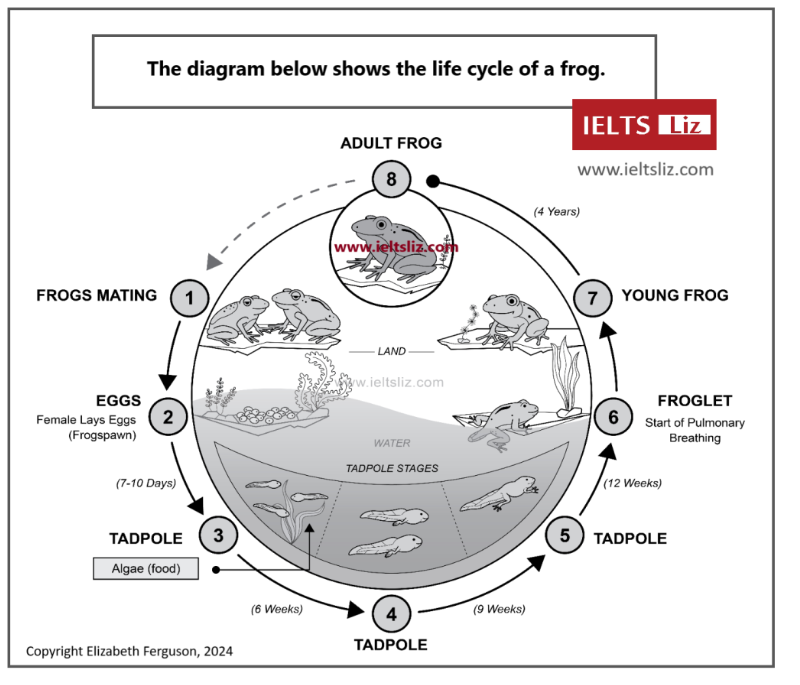
Fill in each gap with a suitable word or phrase. Then click "Show Answers" to check.
The diagram (1) ______ the life cycle of a frog, from mating to adulthood. Overall, there are (2) ______ main stages in this (3) ______, which takes approximately four years to complete. The cycle begins on land and the early stages (4) ______ place in water.
The process begins when adult frogs (5) ______, after which the female (6) ______ eggs, known as frogspawn, in the water. Within 7 to 10 days, these eggs (7) ______ into tadpoles, which feed (8) ______ algae.
(9) ______ the following weeks, the tadpole undergoes (10) ______ changes. At around six weeks, it develops hind legs, and by nine weeks, all four legs have (11) ______. At twelve weeks, the tadpole (12) ______ a froglet and begins breathing with lungs. (13) ______, it leaves the water and grows into a young frog, before reaching (14) ______ at approximately four years of age, at which point the cycle (15) ______ again.
Task 1B — Comparison Diagram
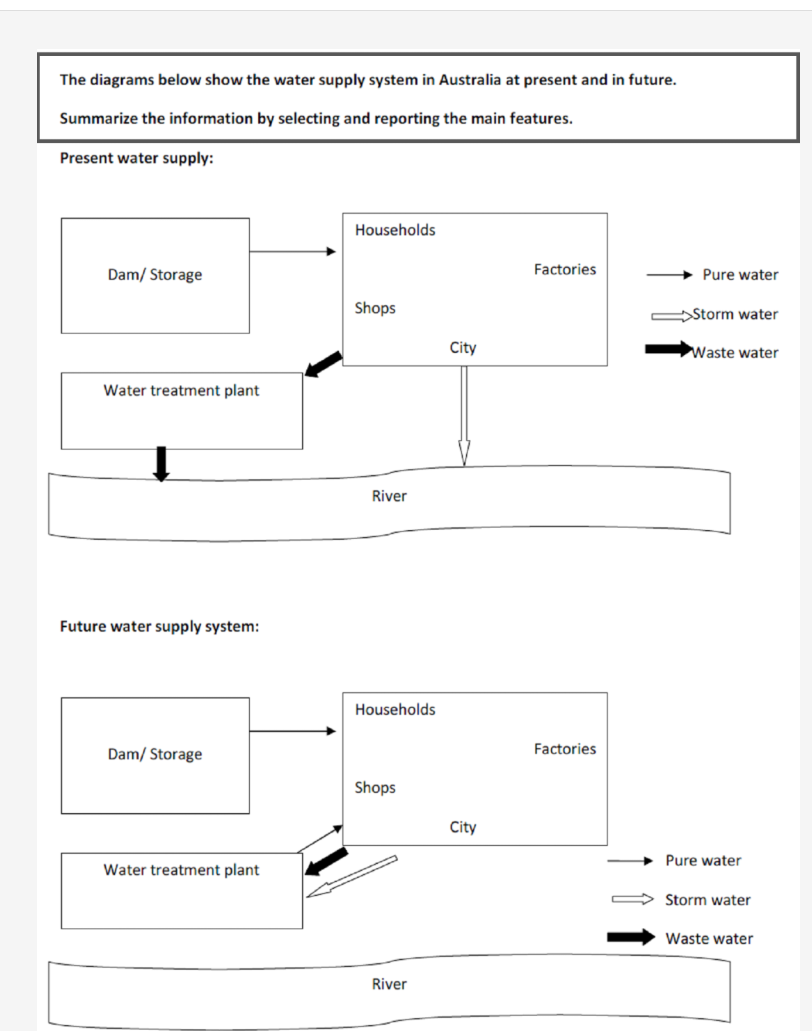
Task 1C — Line Graph
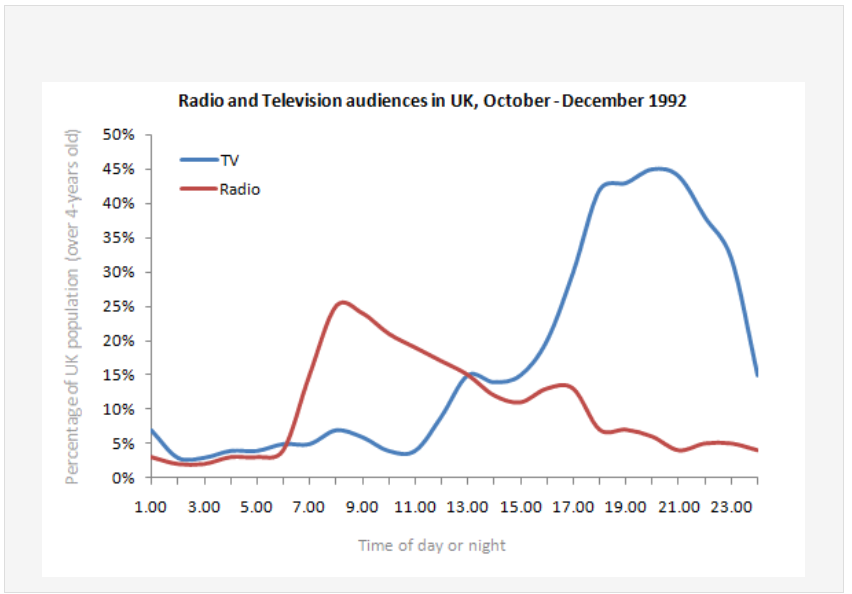
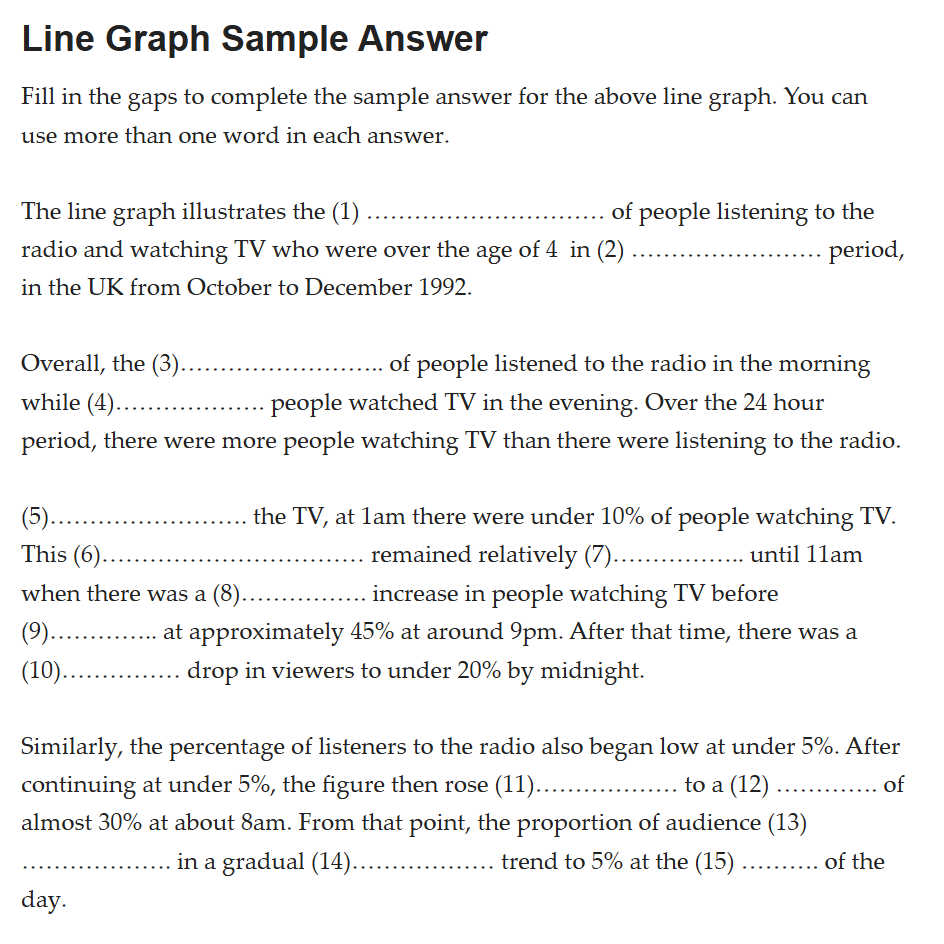
The line graph (1) ______ the percentage of people listening to the radio and watching TV who were over the age of 4 in (2) ______ period, in the UK from October to December 1992.
Overall, the (3) ______ of people listened to the radio in the morning while (4) ______ people watched TV in the evening. Over the 24-hour period, there were more people watching TV than there were listening to the radio.
(5) ______ the TV, at 1am there were under 10% of people watching TV. This (6) ______ remained relatively (7) ______ until 11am when there was a (8) ______ increase in people watching TV before (9) ______ at approximately 45% at around 9pm. After that time, there was a (10) ______ drop in viewers to under 20% by midnight.
Similarly, the percentage of listeners to the radio also began low at under 5%. After continuing at under 5%, the figure then rose (11) ______ to a (12) ______ of almost 25% at about 8am. From that point, the proportion of audience (13) ______ in a gradual (14) ______ trend to 5% at the (15) ______ of the day.
Task 1D — Table & Pie Charts
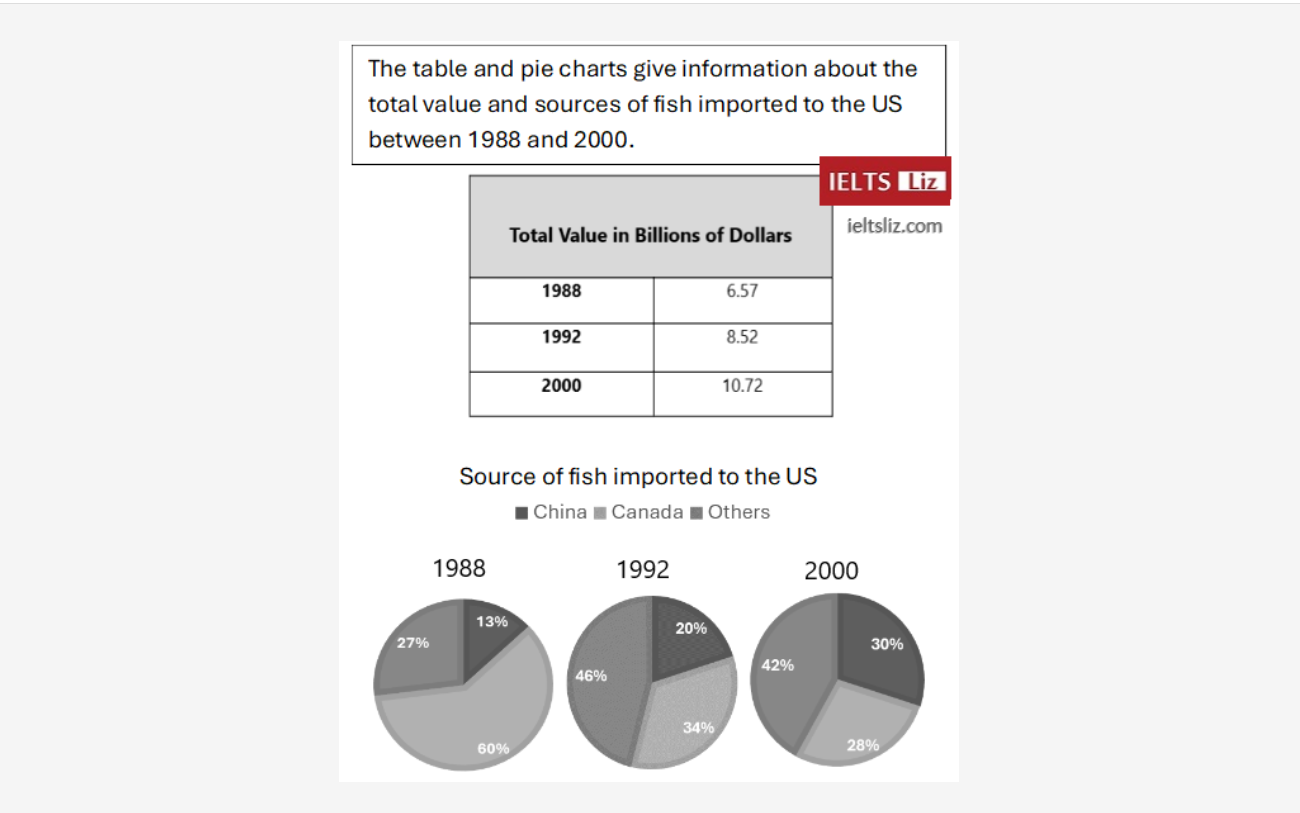
• "The graph says..." → use "shows / illustrates / indicates / reveals"
• "It can be seen from the graph that..." → too wordy. Just describe.
• Copying the question word for word → always paraphrase the introduction
• Listing every number → select the most important features only
• Giving reasons or opinions → Task 1 is description only (no "because..." or "I think...")
• Forgetting the overview → this is the single most important paragraph for your score
IELTS Listening Practice Test
Excellent performance! You only made 3 mistakes across all 4 parts. Part 2 was perfect (10/10). Your errors were in vocabulary recognition (Q8, Q22) and over-specifying an answer (Q36).
PART 1 — GREEK ISLAND HOLIDAYS & INSURANCE (9/10)
| Q | Your Answer | Correct | |
|---|---|---|---|
| 1 | 300 | 300 | ✓ |
| 2 | SunShade | sunshade | ✓ |
| 3 | balcony | balcony | ✓ |
| 4 | forests | forest(s) | ✓ |
| 5 | 319 | 319 | ✓ |
| 6 | 10000 | 10,000 | ✓ |
| 7 | relative | relative | ✓ |
| 8 | Missing | missed | ✗ |
| 9 | item | item | ✓ |
| 10 | Ludlow | Ludlow | ✓ |
The phrase is «missed departure» (past participle used as adjective) — a departure that you missed. «Missing departure» means a departure that is absent/lost, which doesn't fit the insurance context. Listen for the -ed vs -ing ending — they change meaning completely.
PART 2 — WINRIDGE FOREST RAILWAY PARK (10/10) ★
| Q | Your Answer | Correct | |
|---|---|---|---|
| 11 | C | C | ✓ |
| 12 | A | A | ✓ |
| 13 | C | C | ✓ |
| 14 | E | E | ✓ |
| 15 | H | H | ✓ |
| 16 | F | F | ✓ |
| 17 | C | C | ✓ |
| 18 | G | G | ✓ |
| 19 | 120 | 120 | ✓ |
| 20 | 5-12 | 5-12 | ✓ |
PART 3 — STUDY SKILLS TUTORIAL (9/10)
| Q | Your Answer | Correct | |
|---|---|---|---|
| 21 | fishing industry | fishing industry | ✓ |
| 22 | computer modeling | statistics | ✗ |
| 23 | note taking | note-taking | ✓ |
| 24 | confidence | confidence | ✓ |
| 25 | ideas | ideas | ✓ |
| 26 | student support | student support | ✓ |
| 27 | places | places | ✓ |
| 28 | general | general | ✓ |
| 29 | three times | 3 times | ✓ |
| 30 | 25 january | 25 | ✓ |
«Computer modeling» was already listed as a known strength. The question asked for the other strength — «statistics». This is a common trap: the audio mentions both, but you wrote the one already on the page instead of the missing one. Tip: always check what's already filled in before writing your answer.
PART 4 — THE UNDERGROUND HOUSE (9/10)
| Q | Your Answer | Correct | |
|---|---|---|---|
| 31 | B | B | ✓ |
| 32 | A | A | ✓ |
| 33 | strong glass | glass | ✓ ⚠ |
| 34 | insulation | insulation | ✓ |
| 35 | windows | windows | ✓ |
| 36 | electricity surplus | electricity | ✗ |
| 37 | floors | floor(s) | ✓ |
| 38 | waste | waste | ✓ |
| 39 | concrete | concrete | ✓ |
| 40 | 15 years | 15 years | ✓ |
The sentence reads: «the house may produce more (36) _____ than it needs». With «electricity» it works perfectly: «produce more electricity than it needs». With «electricity surplus» it becomes: «produce more electricity surplus than it needs» — grammatically broken. Tip: always read the completed sentence back to check it makes grammatical sense.
The official answer is just «glass». You wrote «strong glass» — this is within the word limit and factually correct, so most examiners would accept it. However, adding extra words is risky: if the extra word contradicts or doesn't match the audio, you lose the mark. Safest approach: write only the word(s) you hear directly.
SCORE BREAKDOWN
| Part | Topic | Score | Band |
|---|---|---|---|
| 1 | Greek Island Holidays & Insurance | 9/10 | Excellent |
| 2 | Winridge Forest Railway Park | 10/10 | Perfect ★ |
| 3 | Study Skills Tutorial | 9/10 | Excellent |
| 4 | The Underground House | 9/10 | Excellent |
| TOTAL | 37/40 | Band 8.5 | |
KEY TAKEAWAYS
- Perfect Part 2 — matching and multiple choice are strong skills
- Numbers, names, and spelling are all accurate
- Good understanding of note-completion format
- Comfortable with all question types (MCQ, matching, table, notes)
- Check what's pre-filled: Q22 — you repeated information already given on the page instead of listening for the missing answer
- Read the sentence back: Q36 — «more electricity surplus than it needs» breaks grammar. Always check the completed sentence sounds natural
- -ed vs -ing endings: Q8 — «missed» (past action) vs «missing» (currently absent) — these small suffixes change meaning
- Don't over-specify: Q33 was accepted, but adding extra words is always a risk. Write only what you hear
37/40 puts you comfortably in Band 8.5 territory. This is a very high listening score. To reach Band 9 (39-40), you'd need near-perfect accuracy. Your error patterns are minor and fixable — focus on reading back completed sentences and checking pre-filled information before writing.
Listening Test 2 — Cambridge IELTS 19
More than doubled your errors (3 → 7). The main problems: MCQ distractor traps (Parts 2 & 3) and spelling/form errors (Part 1). Part 4 was perfect — your strength in note completion remains.
PART 1 — GUITAR GROUP (8/10)
| Q | Your Answer | Correct | |
|---|---|---|---|
| 1 | Mathieson | MATHIESON | ✓ |
| 2 | Beginner | beginners | ✗ |
| 3 | college | college | ✓ |
| 4 | New | New | ✓ |
| 5 | 11 | 11 / eleven | ✓ |
| 6 | instrument | instrument | ✓ |
| 7 | ear | ear | ✓ |
| 8 | Clapping | Clapping | ✓ |
| 9 | recording | recording | ✓ |
| 10 | individually | alone | ✗ |
The audio says «a class for beginners» — plural. You wrote the singular form. In IELTS Listening, spelling and form must be exact. A missing -s costs you the mark. Tip: listen for articles and determiners — «a class for beginners» (plural members), not «a class for beginner» (grammatically wrong).
The transcript says: «he sometimes gets us to play one at a time — you know, alone». You wrote a synonym — «individually» means the same thing, but IELTS requires the exact word from the audio. This is a classic synonym trap: you understood the meaning perfectly but used your own word. Tip: write what you hear, not what you think it means.
PART 2 — LIFEBOAT VOLUNTEER (7/10)
| Q | Your Answer | Correct | |
|---|---|---|---|
| 11 | A | A | ✓ |
| 12 | B | B | ✓ |
| 13 | C | A | ✗ |
| 14 | C | B | ✗ |
| 15 | C | C | ✓ |
| 16 | C | A | ✗ |
| 17 | C / E | C / E | ✓ |
| 18 | C / E | C / E | ✓ |
| 19 | A / B | A / B | ✓ |
| 20 | A / B | A / B | ✓ |
The speaker says: «They gave me tests for colour blindness and they thought I might have a problem there, but it turned out I was OK.» Option A says «might be colour blind» — this matches the audio. Option C (eye surgery) was never mentioned. You were attracted to a distractor. Tip: «might» in the audio = «might» in the answer. Listen for exact paraphrasing, not topics that sound medical.
The audio says: «Our target's to get there in five minutes, then we try to get the boat off the dock and out to sea in another six to eight minutes.» The question asks about getting the boat to sea — that's the 6-8 minutes. «Eight and a half» was never said — 8.5 is a distractor created by combining numbers from the passage. Tip: read the question carefully — it asks about ONE specific step, not the total time.
The speaker says: «I speak to youth groups and sailing clubs in the area about the sorts of problems that sailors and swimmers can have if the weather suddenly gets bad.» This is clearly «gives talks on safety at sea» (option A). Recruiting volunteers (option C) is never mentioned. Tip: «speak to groups about problems» = «give talks on safety.» Practice recognizing paraphrased descriptions.
PART 3 — RECYCLING FOOTWEAR (8/10)
| Q | Your Answer | Correct | |
|---|---|---|---|
| 21 | B | A | ✗ |
| 22 | A | B | ✗ |
| 23 | B | B | ✓ |
| 24 | B | B | ✓ |
| 25 | E | E | ✓ |
| 26 | B | B | ✓ |
| 27 | A | A | ✓ |
| 28 | C | C | ✓ |
| 29 | C | C | ✓ |
| 30 | A | A | ✓ |
The speaker says: «although it's quite interesting, perhaps there isn't enough to say about it.» This means the topic is limited in scope (not enough material) — option A. «Hard to research» (option B) would mean the information exists but is difficult to find, which isn't what was said. Tip: «not enough to say» = limited scope, not difficulty of research.
The speaker says: «they are very hard-wearing, but don't they look a bit casual for school uniform? I don't think they're right for that.» The concern is about suitability for school (option B). Popularity with young people (option A) is a distractor — it sounds related to shoes and youth, but the audio discusses the shoe's appropriateness, not its popularity. Tip: focus on what the speaker's concern is, not just the topic area.
PART 4 — TARDIGRADES (10/10) ★
| Q | Your Answer | Correct | |
|---|---|---|---|
| 31 | move | move | ✓ |
| 32 | short | short | ✓ |
| 33 | discs | discs / disks | ✓ |
| 34 | oxygen | oxygen | ✓ |
| 35 | tube | tube | ✓ |
| 36 | temperatures | temperatures | ✓ |
| 37 | protein | protein | ✓ |
| 38 | space | space | ✓ |
| 39 | seaweed | seaweed | ✓ |
| 40 | endangered | endangered | ✓ |
TEST 2 — SCORE BREAKDOWN
| Part | Topic | Score | Rating |
|---|---|---|---|
| 1 | Guitar Group | 8/10 | Good |
| 2 | Lifeboat Volunteer | 7/10 | Weakest |
| 3 | Recycling Footwear | 8/10 | Good |
| 4 | Tardigrades | 10/10 | Perfect ★ |
| TOTAL | 33/40 | Band 7.5 | |
ERROR PATTERN ANALYSIS
| Pattern | Questions | Count | Severity |
|---|---|---|---|
| MCQ distractor traps | Q13, Q14, Q16, Q21, Q22 | 5 | High |
| Synonym substitution | Q10 | 1 | Medium |
| Spelling / plural form | Q2 | 1 | Medium |
TEST 1 vs TEST 2 — COMPARISON
| Test 1 | Test 2 | Change | |
|---|---|---|---|
| Total Score | 37/40 | 33/40 | ⬇ −4 |
| Band | 8.5 | 7.5 | ⬇ −1.0 |
| Part 1 | 9/10 | 8/10 | ⬇ −1 |
| Part 2 | 10/10 ★ | 7/10 | ⬇ −3 |
| Part 3 | 9/10 | 8/10 | ⬇ −1 |
| Part 4 | 9/10 | 10/10 ★ | ⬆ +1 |
TEST 2 — KEY TAKEAWAYS
- Note completion is your superpower — perfect in Part 4 both tests, 19/20 across all note-completion questions
- Scientific/academic vocabulary causes no problems (tardigrades, cryptobiosis)
- Multi-select questions (Q17-20) — perfect both times
- 5 out of 7 errors were MCQ questions where you picked a distractor
- Pattern: you hear a related word/topic and jump to it before hearing the full answer
- Q13: heard «eye» + medical context → picked surgery (but audio said colour blindness)
- Q14: combined numbers from different parts of the sentence into a wrong total
- Q21/Q22: chose options that sounded plausible but didn't match the speaker's actual point
- Read ALL options before the audio starts — underline key differences between A, B, and C
- Listen for the speaker's main point, not just topic-related words. Ask: «What is the speaker's actual conclusion?»
- Beware of «mentioned but rejected» — the audio often mentions wrong options before giving the answer (Q13: «they thought I might have a problem... but it turned out I was OK»)
- Don't combine numbers — if the question asks about one step, write only that step's number (Q14)
- Wait for the full sentence — don't write your answer until the speaker has finished the point
33/40 is still a strong score, but the drop from 8.5 shows MCQ sections are inconsistent. Your note-completion skills are Band 9 level (19/20 across both tests). The gap between your best and worst question types is the issue. Fixing MCQ strategy alone could push you back to Band 8.5+.
Reading Test — Cambridge IELTS 21, Test 3
Listening Band 7.5-8.5, but Reading Band 5.5 — a gap of 2-3 bands. The main problems: T/F/NG confusion (9 errors), shifted note-completion answers (3 errors), and MCQ in Passage 3 (3 errors). Reading needs targeted strategy work.
PASSAGE 1 — SAVING THE SAIGA (8/13)
| Q | Type | Your Answer | Correct | |
|---|---|---|---|---|
| 1 | Note | dust | dust | ✓ |
| 2 | Note | blood | blood | ✓ |
| 3 | Note | coat | coat | ✓ |
| 4 | Note | target | horns | ✗ |
| 5 | Note | horns | habitat | ✗ |
| 6 | Note | habitat | routes | ✗ |
| 7 | Note | streams | streams | ✓ |
| 8 | T/F/NG | FALSE | FALSE | ✓ |
| 9 | T/F/NG | TRUE | FALSE | ✗ |
| 10 | T/F/NG | TRUE | TRUE | ✓ |
| 11 | T/F/NG | NOT GIVEN | NOT GIVEN | ✓ |
| 12 | T/F/NG | TRUE | TRUE | ✓ |
| 13 | T/F/NG | TRUE | NOT GIVEN | ✗ |
You wrote target → horns → habitat but the correct sequence is horns → habitat → routes. You found the right words from the passage but put them in the wrong gaps. This is a note-completion alignment error — you started reading from the wrong point. The notes say «poaching, especially for the (4) ___ of male saiga» — the passage says «their horns are highly prized.» You wrote «target» (a word from the same sentence) instead of the specific noun that fills the gap grammatically. Tip: read the note structure first, then find the matching sentence. Check that your word fits grammatically in the gap.
Statement: «For most of the 20th century, the population of saiga were falling.» The passage says: «Legal protection ensured its survival for a while, and numbers steadily recovered throughout most of the 20th century.» This directly contradicts the statement — they were recovering, not falling. You confused the 20th century recovery with the post-1991 collapse. Tip: pay attention to time periods — «most of the 20th century» ≠ «the 1990s.»
Statement: «The Initiative's recognition as a World Restoration Flagship project attracted additional international funding.» The passage says it was recognised — but says nothing about funding. You assumed recognition = funding. That's an inference, not a stated fact. Rule: NOT GIVEN means the passage doesn't mention it at all. Don't make logical jumps — only mark TRUE if the passage explicitly says it.
PASSAGE 2 — DAR ES SALAAM TRANSPORT (7/13)
| Q | Type | Your Answer | Correct | |
|---|---|---|---|---|
| 14 | T/F/NG | TRUE | NOT GIVEN | ✗ |
| 15 | T/F/NG | FALSE | FALSE | ✓ |
| 16 | T/F/NG | NOT GIVEN | NOT GIVEN | ✓ |
| 17 | T/F/NG | FALSE | TRUE | ✗ |
| 18 | T/F/NG | TRUE | FALSE | ✗ |
| 19 | Note | phases | lanes | ✗ |
| 20 | Note | boarding | boarding | ✓ |
| 21 | Note | wheelchairs | wheelchairs | ✓ |
| 22 | Note | fuel | fuel | ✓ |
| 23 | Note | floods | flood | ✗ |
| 24 | Note | tickets | smartcards | ✗ |
| 25 | Note | gates | gates | ✓ |
| 26 | Note | Queues | queues | ✓ |
Statement: «The population of Dar es Salaam is rising more rapidly than was previously predicted.» The passage gives population projections (10 million, 13.4 million by 2035, 73.7 million by 2100) but never says these predictions were revised upward. The numbers are the current predictions — there's no comparison with earlier ones. Rule: if the passage gives facts but doesn't compare them to previous claims, it's NOT GIVEN.
Statement: «The majority of the present residential development in Dar es Salaam is unplanned.» The passage says: «Nearly all the expansion is happening on the periphery, and nearly all takes place informally without any agreed strategy.» «Informally without any agreed strategy» = unplanned. This is TRUE. You may have been confused by «informally» not matching «unplanned» exactly — but they mean the same thing here.
Statement: «Dar es Salaam's authorities have decided to follow the public transport plan adopted by a large number of African cities.» The passage says the opposite: «Unlike many cities on the continent, Dar es Salaam isn't trying to build a metro. It has chosen a less exciting but cheaper and more achievable method: the bus.» The word «Unlike» directly contradicts «follow... adopted by a large number.» Tip: watch for contrast words (unlike, however, but, rather) — they often signal FALSE.
The note says: «the buses use designated (19) ___ to cut down on delays.» The passage says: «The DART bus rapid transit (BRT) system runs on bus lanes separated from other traffic.» You wrote «phases» — the passage mentions phases (Phase I, II, III, IV) but those refer to the expansion plan, not what buses drive on. Tip: check the grammar — «use designated phases» doesn't make sense. The word must fit: «use designated lanes.»
The passage says: «A shortage of buses after a serious flood at the main depot.» The article «a» + adjective «serious» signals a single event — «flood» (singular). You wrote «floods» (plural). Rule: match the exact form from the passage. «A flood» = singular.
The note says: «passengers are unable to use (24) ___ because some equipment is out of action.» The passage says: «Smartcards can't be used as the mechanical readers aren't working either, forcing passengers to buy individual paper tickets.» You wrote the wrong noun — passengers can't use smartcards (the equipment is broken), so they're forced to buy tickets instead. «Tickets» is the replacement, not the thing that's broken. Tip: read the full sentence — «unable to use X» means X is the thing that doesn't work.
PASSAGE 3 — RETHINKING THE PAST (7/14)
| Q | Type | Your Answer | Correct | |
|---|---|---|---|---|
| 27 | MCQ | C | A | ✗ |
| 28 | MCQ | A | A | ✓ |
| 29 | MCQ | D | D | ✓ |
| 30 | MCQ | D | A | ✗ |
| 31 | Match | A | E | ✗ |
| 32 | Match | F | F | ✓ |
| 33 | Match | D | D | ✓ |
| 34 | Match | B | B | ✓ |
| 35 | Y/N/NG | YES | NO | ✗ |
| 36 | Y/N/NG | NOT GIVEN | NOT GIVEN | ✓ |
| 37 | Y/N/NG | NO | NOT GIVEN | ✗ |
| 38 | Y/N/NG | YES | YES | ✓ |
| 39 | Y/N/NG | NO | YES | ✗ |
| 40 | Y/N/NG | NOT GIVEN | NO | ✗ |
Question: «What is the writer doing in the second paragraph?» The paragraph lists two key findings: advanced behaviours traced further back in time, and misunderstood gender roles. This is «pinpointing some key changes in our understanding of prehistory» (A), not «summarising attitudes towards recent archaeological revelations» (C). Tip: «pinpointing changes» describes listing specific findings. «Summarising attitudes» would mean discussing what people think — the paragraph doesn't do that.
Question: «What does the writer suggest in the final paragraph?» The final paragraph says: «Inequality, authoritarianism and patriarchy aren't inevitable. They're choices, and prehistory shows us that we can choose differently.» This clearly matches A: «Studying past societies could help us create a fairer society today.» You chose D (reevaluating research influenced by outdated beliefs) — that's the theme of the previous paragraphs, not the conclusion.
Statement: «The findings at Kalambo Falls revealed that...» You chose A: «Homo sapiens emerged at an earlier point in time than experts previously believed.» But the Kalambo Falls logs are 476,000 years old — that's 200,000 years before Homo sapiens. The finding is that another species (not Homo sapiens) was capable of sophisticated workmanship (answer E). Tip: read both the statement AND the sentence endings carefully before matching.
Statement: «Neanderthals' cave paintings were the first examples of artwork ever created.» The passage says: «Even earlier species, such as Homo erectus, may also have made art.» If even earlier species made art, then Neanderthal paintings were NOT the first. The writer disagrees with the statement. Rule: «even earlier species may also have made art» = the writer thinks there was art before Neanderthals = answer is NO.
Statement: «The methods which the researchers used to examine the Rising Star cave system were rather unconventional.» The passage discusses the publication method (non-traditional journal, public peer reviews) — but says nothing about the research methods used in the cave. Publication ≠ research method. The passage doesn't mention how they examined the cave. Rule: if the passage discusses a related but different topic, it's NOT GIVEN.
Statement: «The means used to publicise the findings from the Rising Star cave system added to the controversy that surrounds them.» The passage says: «The dispute has only been heightened by the way the results were released, in a non-traditional journal that publishes peer reviews publicly alongside the paper.» «Heightened the dispute» = added to the controversy. The writer agrees. Tip: «heightened» = made worse = the publication method DID add to the controversy = YES.
Statement: «The size of H. naledi brains is a key factor in the question of whether these hominins were able to produce art.» The writer says: «I think the species' small brains are a distraction.» Calling brain size «a distraction» means the writer thinks it's NOT a key factor — the answer is NO. Tip: «distraction» = irrelevant = the writer disagrees that it's a key factor.
SCORE BREAKDOWN
| Passage | Topic | Score | Rating |
|---|---|---|---|
| 1 | Saving the Saiga | 8/13 | Weak |
| 2 | Dar es Salaam Transport | 7/13 | Weakest |
| 3 | Rethinking the Past | 7/14 | Weakest |
| TOTAL | 22/40 | Band 5.5 | |
ERROR PATTERN ANALYSIS
| Pattern | Questions | Count | Severity |
|---|---|---|---|
| T/F/NG & Y/N/NG confusion | Q9, Q13, Q14, Q17, Q18, Q35, Q37, Q39, Q40 | 9 | Critical |
| Note completion — shifted answers | Q4, Q5, Q6 | 3 | High |
| MCQ — wrong interpretation | Q27, Q30, Q31 | 3 | Medium |
| Note completion — wrong word | Q19, Q24 | 2 | Medium |
| Spelling / form error | Q23 | 1 | Low |
T/F/NG ERROR BREAKDOWN
| Your Answer | Correct Answer | Count | Problem |
|---|---|---|---|
| TRUE/YES | FALSE/NO | 3 | Missed contradiction signals (Q9, Q18, Q35) |
| TRUE/YES | NOT GIVEN | 2 | Made assumptions beyond text (Q13, Q14) |
| FALSE/NO | TRUE/YES | 2 | Missed paraphrase match (Q17, Q39) |
| FALSE/NO | NOT GIVEN | 1 | Confused related topic with actual claim (Q37) |
| NOT GIVEN | FALSE/NO | 1 | Missed that writer explicitly disagreed (Q40) |
SKILL COMPARISON
| Skill | Test | Score | Band |
|---|---|---|---|
| Listening | Practice Test 1 | 37/40 | 8.5 |
| Listening | Cambridge IELTS 19 | 33/40 | 7.5 |
| Reading | Cambridge IELTS 21 | 22/40 | 5.5 |
ACTION PLAN: READING STRATEGY
Step 1: Does the passage mention this topic at all? → If NO → NOT GIVEN
Step 2: Does the passage say the same thing (even in different words)? → If YES → TRUE
Step 3: Does the passage say the opposite? → If YES → FALSE
If the passage discusses a related topic but not the exact claim → NOT GIVEN
Q13: «recognition → funding» = YOUR assumption, not in the text
Q14: «big numbers → rising faster than predicted» = YOUR interpretation
Rule: if you're thinking «well, that makes sense» rather than «the passage says this» — it's NOT GIVEN.
Q18: «Unlike many cities on the continent» → the opposite of what those cities do → FALSE
Q9: «numbers steadily recovered» → opposite of «falling» → FALSE
a) Read the note around the gap — what part of speech fits? (noun? verb? adjective?)
b) Check what comes before and after the gap grammatically
c) Then find the matching sentence in the passage
d) Pick the word that fits the gap, not just any word from the sentence
Q4: «especially for the (4) ___ of male saiga» → needs a NOUN → passage says «horns are highly prized» → answer is «horns»
22/40 places you at Band 5.5, which is below the typical IELTS target of 6.5-7.0. Your listening is strong (7.5-8.5), so the reading gap suggests this isn't a comprehension problem — it's a strategy problem. You understand the text but don't apply T/F/NG rules correctly, and you rush through note completion without checking grammar. Focused practice on T/F/NG alone could lift you to Band 6.5+.
Homework — Question → Answer → Correction
Each exercise shows the original question, your answer, and the correction with explanation.
EXERCISE D — ACTIVE → PASSIVE (6/8)
EXERCISE E — CORRECT THE ERROR (5/6)
EXERCISE G — COLLOCATIONS (8/10)
SUMMARY — WORD CHOICE ERROR
WRITING TASK 1 — SCORES
All Perfect Tense Forms — Explanation & Exercises
Band 7+ requires a range of complex structures used accurately. Perfect tenses show the examiner you can express relationships between time periods — not just "what happened" but "what had happened before," "what has been happening since," and "what will have happened by."
1. PRESENT PERFECT SIMPLE
Signals: since, for, already, yet, just, recently, so far, this week/month/year, ever, never
Active: Scientists have discovered a new species.
Passive: A new species has been discovered (by scientists).
Common error: "The report was published this year" → "The report has been published this year" (unfinished time)
2. PRESENT PERFECT CONTINUOUS
Signals: since, for, all day/week, how long, lately, recently
Example: Researchers have been studying this phenomenon for decades.
Example: The government has been investing heavily in renewable energy since 2015.
vs Simple: "I have read the report" (finished) vs "I have been reading the report" (still reading or just stopped)
3. PAST PERFECT SIMPLE
Signals: before, after, by the time, already, until, when (+ past simple)
Active: The government had already introduced the policy before the crisis began.
Passive: The policy had already been introduced before the crisis began.
IELTS use: "By 2010, the number of users had reached 50 million." (Writing Task 1 — describing data at a point in the past)
4. PAST PERFECT CONTINUOUS
Signals: for, since, before, when, by the time, all day
Example: Scientists had been warning about climate change for years before governments took action.
Example: She had been living in Moscow for ten years when she decided to move.
IELTS Speaking: "Before I started university, I had been working as a translator for two years."
5. FUTURE PERFECT SIMPLE
Signals: by (+ future time), by the time, before, by then
Active: By 2030, the population will have exceeded 9 billion.
Passive: By 2030, the project will have been completed.
IELTS Writing: "By the end of this century, sea levels will have risen by up to one metre."
6. FUTURE PERFECT CONTINUOUS
Signals: by, for, by the time
Example: By next year, she will have been studying English for six years.
Example: By 2030, this city will have been growing for three consecutive decades.
EXERCISES
Fill in the correct perfect form of the verb in brackets.
Each sentence has one tense error. Find and correct it.
Replace the Word — Same Meaning
Replace the underlined word or phrase with a synonym. The meaning of the sentence must stay the same.
Replace the bold word with a more formal or academic alternative.
Rewrite each sentence replacing ALL bold words. Keep the meaning identical.
Phrasal Verbs & Collocations for IELTS
KEY PHRASAL VERBS FOR IELTS
ADVANCED COLLOCATIONS FOR BAND 8+
Replace the bold phrasal verb with a single formal word suitable for academic writing.
Choose POSE, EXERT, YIELD, UNDERGO, BEAR, or REACH to complete each sentence.
IELTS Writing Task 1 — Practice
Two new question types: a process diagram and a bar chart. Write at least 150 words for each. Use the structure: introduction → overview → detail paragraph 1 → detail paragraph 2.
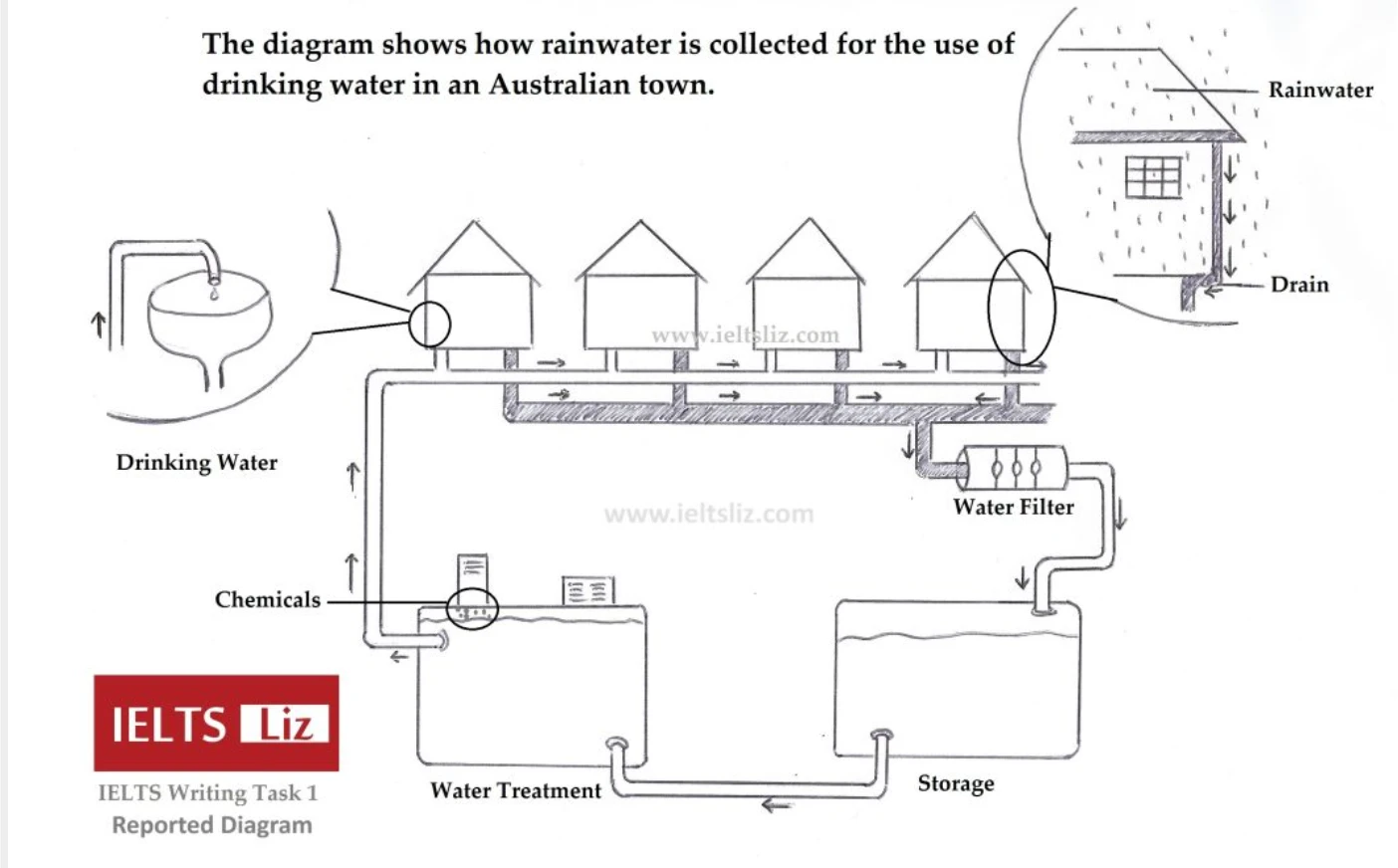
Task 1E — Process Diagram
YOUR ANSWER (150+ WORDS)
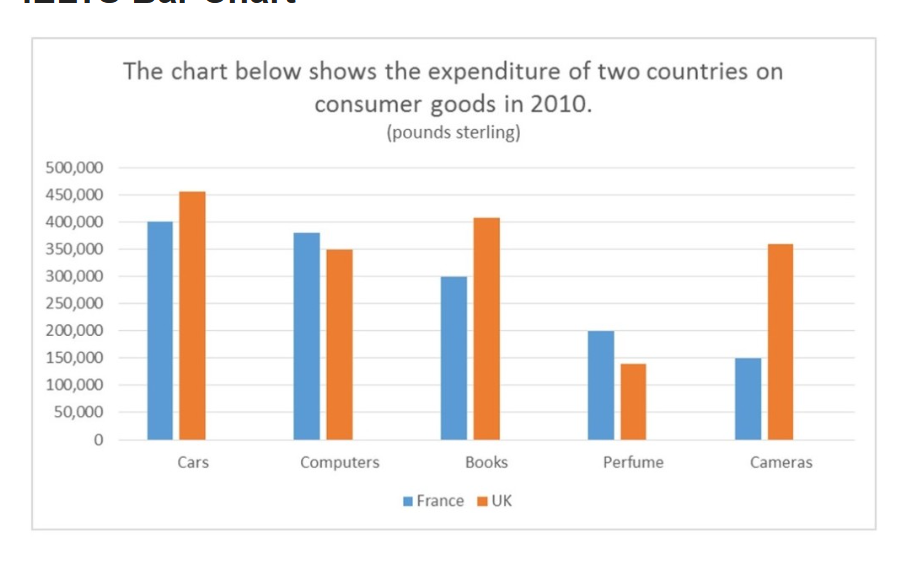
Task 1F — Bar Chart
YOUR ANSWER (150+ WORDS)
• Use passive voice throughout: "water is collected," "chemicals are added"
• Sequence with: "initially," "following this," "subsequently," "at the next stage," "finally"
• Don't list every detail — group related steps
Bar chart tips:
• Never describe every bar individually — group and compare
• Use "while" / "whereas" to contrast within one sentence
• Approximate numbers: "roughly," "approximately," "just under/over"
• The overview should name the overall winner + biggest difference
Homework — Question → Answer → Correction
Exercises J, K, L, M, N, O + Writing Tasks 1E & 1F
EXERCISE J — PERFECT TENSES (4/8)
EXERCISE K — CORRECT THE ERROR (3/6)
EXERCISE L — SYNONYM REPLACEMENT (6/10)
EXERCISE M — REWRITE SENTENCES (5/5)
Outstanding paraphrasing: "widely believed," "obtaining a higher education qualification," "primary cause," "absence of physical exercise," "technological advancements," "the manner in which children acquire knowledge," "certain academics object to," "allocate greater financial resources," "alleviate gridlock." These are genuine Band 8–9 level synonyms used accurately and naturally. Massive improvement in vocabulary range.
EXERCISE N — FORMAL EQUIVALENTS (6/8)
EXERCISE O — ADVANCED COLLOCATIONS (5/6)
WRITING TASK 1E — RAINWATER COLLECTION
"The diagram illustrates the way a town in Australia collects and processes rainwater to be used for drinking."
"Overall, the process is a closed-loop system consisting of 6 steps, starting with the collection of rainwater and finishing its delivery as drinking water."
"In the initial stage of the process, rainwater is collected from rooftops and is channelled into downpipes through a gutter and drain system. All the collected water from the row of houses is then funnelled via underground pipes into a specialized water filter. This stage removes debris and impurities before the water is transferred to a large water storage tank."
"Following storage, filtered water flows into a water treatment tank, where it goes through chemical purification. At this stage, specific chemicals are added to the water, which destroy any remaining bacteria and make water safe for consumption. After treatment, clean drinking water is supplied to homes via a separate pipeline and reaches the residents' taps."
Superb use of passive voice throughout ("is collected," "is channelled," "is transferred," "are added," "is supplied"). Excellent overview with "closed-loop system" — this is exactly the kind of sophisticated summary that scores Band 8+. Strong vocabulary: "funnelled," "debris and impurities," "chemical purification." The 4-paragraph structure is perfect, and sequencing language is varied and natural ("In the initial stage," "Following storage," "At this stage," "After treatment").
• "finishing its delivery" → "finishing with its delivery" (preposition needed)
• "make water safe" → "make the water safe" (missing definite article — the water we are discussing)
• Consider: "consisting of 6 steps" — write out numbers under 10 in formal writing: "consisting of six steps"
WRITING TASK 1F — BAR CHART (CONSUMER GOODS)
"The bar chart compares the amount of money spent by consumers in France and the United Kingdom on five different categories of consumer goods - cars, computers, books, perfumes and cameras in 2010. The units are measured in pounds sterling."
"Overall, the UK spent more than France on most of the listed goods, especially on cars, books and cameras. In France, by contrast, spending was higher only on computers and perfumes. For both countries, the largest expense category was cars, while the least amount of money was spent on perfumes and cameras."
"In 2010, car expenses topped the list of the largest expenditures in both countries: in the UK, about £450,000 was spent on them, and in France - exactly £400,000. In addition, the UK spent significantly more on books and cameras than France. Expenditures on books in the UK amounted to just over 400,000 pounds sterling, in France - 300,000 pounds sterling, and on cameras - even more: in the UK, about 360,000 pounds sterling were spent on them, which is more than twice the modest sum of 150,000 pounds sterling in France."
"France, by contrast, spent more on computers and perfumes. Expenditure on computers in France amounted to approximately 380,000 pounds sterling, which is slightly more than in the UK, where 350,000 pounds sterling were spent on them. France spent 200,000 pounds sterling on perfumery, which was their second-highest figure, but still significantly exceeded the UK spending, which dropped to a minimum of about 140,000 pounds sterling."
Excellent overview identifying the key pattern (UK higher on most, France on computers/perfumes). Good use of data with varied approximating language ("about," "exactly," "just over," "approximately"). Strong comparison language: "by contrast," "more than twice," "slightly more than." All key data points are covered and accurately reported.
You wrote France spent £200,000 on perfume and called it "their second-highest figure." But France's spending was: cars £400k > computers £380k > books £300k > perfume £200k > cameras £150k. Perfume was France's FOURTH-highest, not second. Inaccurate data reporting costs marks in Task Achievement. Always double-check your rankings against the chart.
• Dash punctuation (Russian style): "in France - exactly £400,000" — English doesn't use a dash like this for comparisons. Use: "while in France the figure was exactly £400,000" or "compared to £400,000 in France"
• "The units are measured in" — awkward phrasing. Better: "The figures are given in pounds sterling" or simply "measured in pounds sterling"
• "perfumery" → "perfume" — "perfumery" means the shop/industry, not the product. The chart says "perfume"
• Inconsistent number formatting: you switch between "£450,000" and "400,000 pounds sterling" — pick one format and stick with it
• Third paragraph is overloaded: too many data points in one paragraph makes it hard to follow. Consider splitting by "UK-dominant categories" and "France-dominant categories" (which you do in paragraph 4 — good! But paragraph 3 tries to cover too much)
OVERALL ASSESSMENT
- Exercise M is perfect: Band 8–9 paraphrasing — "allocate greater financial resources," "alleviate gridlock," "technological advancements" — outstanding academic vocabulary
- Task 1E is near-perfect: "closed-loop system," excellent passive voice, strong process language — Band 8–8.5
- Phrasal verb knowledge is strong: 6/8 correct formal equivalents in Exercise N
- Advanced collocations understood: pose, undergo, yield, reach, bear all used correctly
- Perfect tenses remain the weakest area (4/8 in Ex J, 3/6 in Ex K): The pattern: you confuse WHICH perfect tense to use. "By + past date" = past perfect. "By + future date" = future perfect. "Since / so far / this year" = present perfect. Drill this rule.
- Present perfect vs past perfect (again): Q5 in Ex J — "so far this year" needs PRESENT perfect, not past perfect. This is the SAME error from your previous homework. You need to anchor: unfinished time = present perfect.
- "Comings and goings" (Ex L Q9): This is a false friend — memorise what it actually means (people moving in/out), NOT advantages/disadvantages.
- Word precision at Band 8+: "atrocious" ≠ "severe," "inspect" ≠ "examine," "emerged" ≠ "proved," "perfumery" ≠ "perfume" — at Band 8+, choosing a word that's ALMOST right but slightly off costs marks.
- Russian punctuation transfer: Stop using dash ( - ) for comparisons in English. Use "while," "whereas," "compared to" instead.
Your vocabulary and paraphrasing skills are now genuinely Band 8+ (Exercise M is proof). Writing Task 1E shows real mastery of process descriptions. The remaining gap is tense selection in perfect forms — this is holding you back from 8+ in grammar. The good news: it's a learnable rule system, not intuition. Next session, we'll focus on drilling the "by + time" → which perfect tense formula.
Compiled from 5 IELTS textbooks: Academic Writing (Zemach & Rumisek), Complete Guide to Task 1 Writing (Biggerton), Essay Writing for English Tests (Duigu), Improve Your Written English (Field), Get IELTS Band 9 (Cambridge Consultants). Tailored to your specific weak areas.
PART A — WRITING TASK 1: DATA ESSAYS
Step 1 — Analyse (1 min): Is it static data (one time point → compare sizes) or movement data (multiple time points → compare changes)? Read both axes. Check units and multipliers ("000s" = thousands). Check if dates are past, present, or future → this determines your tense.
Step 2 — Group & Select (4 min): Which items share a similar pattern? Which are different? Identify trends (shared patterns) and exceptions (items that behave differently). Select only key figures — never list all data sequentially.
Step 3 — Write (15 min):
• Introduction (1 sentence): Paraphrase the task. No figures. No opinions.
• Body (1–3 paragraphs): Trend → selected figures → exceptions. Use contrast language.
• Summary (1–2 sentences): Restate key trends. No figures. "Overall / In summary."
| Section | What to write | Words |
|---|---|---|
| Introduction | Paraphrase the task description. Mention what the chart shows, units, time period. NO figures, NO opinions. | 25–30 |
| General Statement | One-sentence overview: the overall trend (for time data) OR the largest/smallest values (for static data). | 25–30 |
| Body | Group 1: trend + 2–3 key figures. Group 2: trend + figures + exceptions using "however / by contrast." | 90–100 |
| Summary | Restate the main trend and key exception in general terms. Use synonyms. No new figures. | 15–25 |
Target total: 150–220 words.
Never copy the question. Use these synonym swaps:
| Original | Paraphrased |
|---|---|
| "shows information about" | "compares and contrasts data on" |
| "several technology companies" | "three different hi-tech companies" |
| "2004 to 2006" | "over a three-year period from 2004 to 2006" |
| "quarterly revenue" | "income per quarter" |
| "in billions of US dollars" | "measured in billions of US dollars" |
| "changes in the number of" (count nouns) | "changes in the amount of" (non-count nouns) |
Rules: Never write "shows that" in the intro (save for body). Don't write "below" (the answer sheet has no diagram). If 4+ categories, say "X different categories" — don't list them all.
rose, increased, climbed, grew, surged, jumped, strengthened, enhanced, maximised
fell, declined, dropped, decreased, diminished, dwindled, plummeted, weakened, tailed off
remained stable, fluctuated around, levelled off, peaked at, troughed at, plateaued
Rate modifiers: dramatically, considerably, significantly, steadily, slightly, rapidly, progressively, markedly
Two sentence structures:
- Verb + Adverb: "Sales rose dramatically to 6 million."
- Adjective + Noun: "There was a dramatic rise in sales."
| Preposition | Use | Example |
|---|---|---|
| to | Direction / target | "rose to a peak of 6 million" |
| by | Amount of change | "fell by 37,000" |
| of | Size of change (noun) | "a decrease of 5 million" |
| from…to | Start to end point | "increased from 2m to 5m" |
| at | Exact position | "remained at 30%" |
| over / under | Approximation | "just over $65,000" |
| above / below | Comparison | "Sales in Brazil were always above those of the other countries" |
| during | Period | "during the first half of this decade" |
| since / for | Duration | "had risen since 2003" / "fell for three consecutive years" |
• Past dates given (e.g. 2002, 2012) → past simple ("rose," "fell")
• No year / current year → present simple ("shows," "illustrates")
• Future estimates → "is predicted/forecast/estimated to"
• Process diagrams → present simple passive ("is placed," "are transported")
• "Since / so far" → present perfect (NOT past perfect!)
• "By + past date" → past perfect ("had risen")
• "By + future date" → future perfect ("will have risen")
SWITCHING GROUPS:
Regarding X… / Looking at X… / Turning to X… / It is clear that…SIMILARITIES:
similarly / likewise / in the same way / a similar patternEXCEPTIONS:
however / by contrast / conversely / whereas / on the other hand- Including personal opinion or causes. Never explain WHY in Task 1.
- Putting figures in intro or summary. Both must be figure-free.
- Intro or summary too long. Intro = 1 sentence. Summary = 1–2 max.
- Using contractions ("don't" → "do not").
- Listing data in chart order (left to right). You must GROUP and analyse.
- Not describing trends and exceptions. This is the Band 7+ differentiator.
- Using too many figures. Select key figures only.
- Under 150 words. Aim for 150–220.
- Misreading units (check "000s," "millions" on axes).
- Wrong tense (see tense rules above).
PART A2 — WRITING TASK 1: PROCESSES
- Always use PASSIVE VOICE: "The trays are placed in the oven" — never "You place the trays" or "They place the trays."
- Always use PRESENT SIMPLE tense (because processes are routine/habitual).
- No general statement needed — go straight to the body after the introduction.
- Body ≈ 130 words (more than data essays because no general statement).
- Turn nouns into verbs: production → produce, fertilisation → fertilise, delivery → deliver.
- Add WHY at each stage: "in order that…" / "which results in…" / "so that…" / "to ensure that…"
Time order phrases (use a different one each time): Next / Then / Subsequently / After this / Initially / At first / Secondly / Finally / Following this / "Once this stage has been completed" / "When this has been done"
PART B — WRITING TASK 2: ESSAYS
Every question has 3 components:
1. Instruction words — what to do ("discuss," "to what extent do you agree")
2. Key words — the topic (Internet, education, environment)
3. Focus words — which ASPECT of the topic you must address
Common mistake: Students see the topic and start writing without reading the focus words. Three questions about "the Internet" can demand three completely different essays.
"To what extent" = "how much": Your answer should be fully agree / partly agree / fully disagree. It is always acceptable to partly agree.
Jot down any ideas in random order, in note form. Don't filter yet.
Think of specific concrete examples first, then group them into abstract categories.
Know nothing about the topic? Think: what would happen if the OPPOSITE were true?
Always consider counter-arguments. Makes your essay more balanced and gives more material.
| Section | What to write | Sentences |
|---|---|---|
| Introduction |
Sentence 1: General statement about the situation. Sentence 2: Narrow to specific aspect (use "however" / "but"). Sentence 3: Your position (thesis statement). CRITICAL: Paraphrase the question — copied words are IGNORED by examiners. |
2–3 |
| Body 1 | Topic sentence (main supporting point) + supporting details + specific examples. | 4–6 |
| Body 2 | Second supporting point (or counter-argument) + evidence + examples. | 4–6 |
| Body 3 (optional) |
Third point, or synthesis of both sides. Rank ideas by importance. | 3–5 |
| Conclusion | Summary of main argument + implications/recommendation. Never introduce new ideas. Can be 1 sentence. | 1–3 |
Step 1: Write "I think that…" + your opinion.
Step 2: Cross out "I think that." What remains is your thesis.
Rules: It must be an arguable opinion (NOT a fact). It must NOT state two sides equally ("There are advantages and disadvantages…" is WEAK). It should preview the points your body paragraphs will discuss.
| Function | Words & Phrases |
|---|---|
| Contrast (intro) | but, however, nevertheless, by contrast, on the other hand, in spite of this, while, whereas, although |
| Addition (body) | also, furthermore, moreover, in addition, not only…but also, both…and |
| Cause/Effect | therefore, consequently, for this reason, as a result, because of this |
| Examples | for example, for instance, such as (+ noun, never a clause) |
| Emphasis | in fact, what is more, in particular |
| Conclusion | in conclusion, therefore, consequently, clearly, on the whole, generally speaking |
| Implications | otherwise, in this case, under these circumstances + future tense |
Warning: "Firstly… Secondly… Thirdly… Finally… In conclusion" at the start of every paragraph = formulaic writing. Examiners penalise this.
Unity = every sentence connects to the thesis/topic sentence. Edit by crossing out any sentence that doesn't relate.
Coherence = ideas in clear logical order. Three tools:
- Transitions: however, furthermore, as a result, for example, in contrast
- Pronoun references: "This policy… It also…" — connects sentences
- Repetition of key nouns: repeat important words to keep the reader oriented
PART C — STYLE MISTAKES TO AVOID
"The Internet has made life more convenient for everyone."
Fix: "The Internet has made life more convenient for many people in developed countries."
Use: few, many, most, sometimes, often, generally, widespread
"Traffic congestion is an absolute disaster in all cities."
Fix: "Traffic congestion is a significant problem in most major cities."
Use modals: may, might, could, should. Use: "some people believe," "it is generally agreed"
"It is clear that nuclear energy is likely to be a possible solution."
Pick ONE level of certainty: "Nuclear energy is likely to be a solution" OR "It is clear that nuclear energy is the answer."
"Nowadays sports are likely to be common throughout the world." ← meaningless
Fix: Have concrete ideas BEFORE writing. Every sentence must add new information.
"More" is a COMPARATIVE, not an intensifier. "People are more interested in making money" means more than BEFORE or more than something else — it does NOT mean "very interested." Always ask: more than what?
PART D — GRAMMAR & PUNCTUATION ESSENTIALS
- Separate list items: "She was elegant, poised, self-confident and beautiful."
- After opening dependent clause: "Because she missed the train, she was late." — but NO comma when the main clause comes first: "She was late because she missed the train."
- Around inserted information: "The house, which had once been beautiful, was now a ruin."
- NEVER use commas instead of full stops (comma splice): "He was in a hurry, he pushed the newspaper into the bin." → "He was in a hurry. He pushed the newspaper into the bin."
| Error | Rule |
|---|---|
| "Tracy and me are going." | "Tracy and I are going." — Test: remove the other person. "Me is going" = wrong. |
| "gave sweets to John and I" | "gave sweets to John and me" — "gave sweets to I" = wrong. |
| "Everyone have their books." | "Everyone has his or her book." — each/everyone/nobody = SINGULAR. |
| "could of / would of" | "could have / would have" — "of" is never a verb. |
| "different to" | "different from" — you differ FROM something. |
| "it's whiskers" (possessive) | "its whiskers" — possessive pronouns NEVER take an apostrophe. |
its (possessive) / it's (it is / it has)
to / too (also/excessive) / two (number)
affect (verb) / effect (noun)
advise (verb) / advice (noun)
principal (head/main) / principle (rule)
passed (verb) / past (noun/prep)
Tip: the VERB has an S before the E (advise, practise); the NOUN has a C before the E (advice, practice).
- Short vowel → double consonant: bit → bitten, hop → hopping, let → letting
- Long vowel (silent e) → drop e, single consonant: hope → hoping, date → dating
- "i before e except after c" (when pronounced "ee"): grief, niece BUT ceiling, receive. Exceptions: weird, seize, neither
- Y → I before suffixes: happy → happily, marry → married
- Words ending in s/x/z/sh/ch: add "es" → brushes, churches, foxes
- Every sentence needs a subject + finite verb. If it has two finite verbs, the clauses must be linked properly.
- Three ways to link clauses: full stop / semicolon / conjunction (because, although, when, if, while, since, unless)
- Dependent clause first → comma required: "Although he failed, he tried again."
- Main clause first → no comma: "He tried again although he failed."
- Vary sentence length — mix short and long sentences for readability.
PART E — EXAM TIME MANAGEMENT
- 1 min — Analyse the data type, axes, units
- 4 min — Group data, find trends, select key figures
- 13 min — Write (intro → general statement → body → summary)
- 2 min — Proofread: tenses, articles, spelling
- 3 min — Read question, identify focus words, brainstorm
- 5 min — Outline (thesis + 2–3 main ideas + supporting points)
- 27 min — Write (intro → body paragraphs → conclusion)
- 5 min — Proofread: check all parts of question answered, unity, grammar
Shortcut: Write all topic sentences FIRST (leaving space), then go back and fill in details.
PART F — YOUR PERSONAL ACTION PLAN
Based on your homework performance (4/8 in Ex J, 3/6 in Ex K), this is the single biggest thing holding you back from Band 8+.
"since / so far / this year / recently" → PRESENT perfect (has/have + past participle)
"by + past date" / "before + past event" → PAST perfect (had + past participle)
"by + future date" / "by the time + future" → FUTURE perfect (will have + past participle)
"for 3 hours by then" / continuous action → add CONTINUOUS (been + -ing)
Your vocabulary is genuinely Band 8+ (Exercise M proved this), but you sometimes choose words that are ALMOST right:
- "atrocious" ≠ "severe" — atrocious = morally shocking; severe = very serious
- "inspect" ≠ "examine" — inspect = official check; examine = study carefully
- "perfumery" ≠ "perfume" — perfumery = the shop/industry
- Rule: If unsure about a word, use a simpler one you're certain about. Simple and correct beats sophisticated and wrong.
- Stop using dashes for comparisons: "in France - exactly £400,000" → "while in France the figure was £400,000"
- Comma splice (very common in Russian-English transfer): Russian uses commas where English needs full stops or semicolons.
- False friends: "comings and goings" ≠ advantages/disadvantages. It means people moving in/out.
| Week | Focus | Activity |
|---|---|---|
| 1–2 | Perfect tenses | Complete 10 tense-selection exercises. For every sentence, say the time signal out loud BEFORE choosing the tense. |
| 3–4 | Task 1 structure | Write 3 complete Task 1 essays using the 3-step process. Time yourself (20 min). Focus on grouping data into trends, not listing. |
| 5–6 | Task 2 structure | Write 2 Task 2 essays. Spend 3 min analysing the question BEFORE brainstorming. Use the thesis formula. Check for overgeneralisation. |
| 7–8 | Style & polish | Review your essays for: comma splices, dash usage, word precision, "more" trap, formulaic language. Rewrite weak paragraphs. |
Daily habit: Read 1 model Band 9 answer per day (Task 1 or Task 2). After reading, write down 3 phrases or structures you want to steal.